Hello,
If you are reading this, you have probably sat through the pitch before. The polished deck, the confident partner, the finance programme that was going to change everything.
And you have probably lived what came after.
Most programmes go wrong in ways nobody writes down.
The business case was sound and the budget was approved. Then, somewhere around the first data tie-out, things got tense. The scope being built was not quite the scope you signed. The design document had 3 versions and nobody could say which one was current. Decisions were made in 1 meeting and unmade in another you were not invited to.
You raised it and were told that is just how these programmes go. Then came the change requests and the revised estimate. By go-live, the people who designed the system had moved on to other clients, and your team was handed something it could not run, maintain or extend.
Then the board asked whether the business case had paid off, and you spent weeks trying to prove it.
The problem is not your people. It is a model that bills for time, so nothing has a reason to be finished.
We named the firm after what the industry lost. Constancia is Latin for constancy, perseverance and a written record. We chose it because those are the 3 things this industry seems to have forgotten.
We spent our careers inside this world, running programmes for global consultancies and building regions for the software vendors. From the vendor side, we watched firm after firm implement the same products with the same gaps. Nothing was traceable, testing never happened and escalations never reached anyone who could act.
We did not leave because that model failed us. We left because there is a better way to do this work, and we wanted to prove it.
Transformations rarely fail on the big things. They fail on the small ones.
A report built to spec over 4 weeks, before anyone asked how the CFO would read it. They wanted a PDF on their phone, so it goes back to be rebuilt and a change order follows.
A workflow owner back from 2 weeks of leave, pointed at a 90-minute recording to catch up. A problem that sat under 40 emails for a month, when 1 phone call would have solved it.
So we ask before we build. Every time.
Our price is fixed, because we start with your data model.
Before we quote, we learn how your business runs, what your architecture looks like and whether your data model can support the outcome you want.
We already know the balance sheet will not tie out until it reconciles to your source systems, and that some of those systems will extract in formats your new platform will not accept. Elsewhere, those discoveries become change orders. With us, they are in the price, because we found them before we quoted. Your data quality will never be our excuse.
A fixed price is what a promise looks like when the person making it shares the risk of being wrong.
When we leave, the system is yours.
We built Constancia to be AI-native, with people in the loop. Our method and tools sit inside every stage of the work, so nothing depends on which consultant was in the room. Documentation, traceability and sign-off happen as we go. User testing means something. Your team gets guides it can pick up cold.
Every decision and document from your programme lives in Constancy, a single record you can ask questions of. What changed while I was away? Why did we decide that in March? Who owns this workflow? You get the answer straight away, for as long as you own the system.
Our clients are organisations with $100 million to $2 billion in revenue, and we work with the finance and operations leaders who will be held accountable for the result. We know what that feels like, because we have carried it ourselves.
We will not fix this industry on our own. But if this sounds less like a pitch and more like the last 3 years of your working life, we should talk.
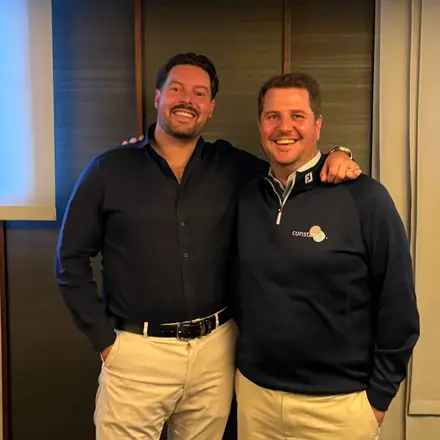
AlexCo-founder and CEO
Alex on LinkedIn, opens in a new tabBradCo-founder and COO
Brad on LinkedIn, opens in a new tab