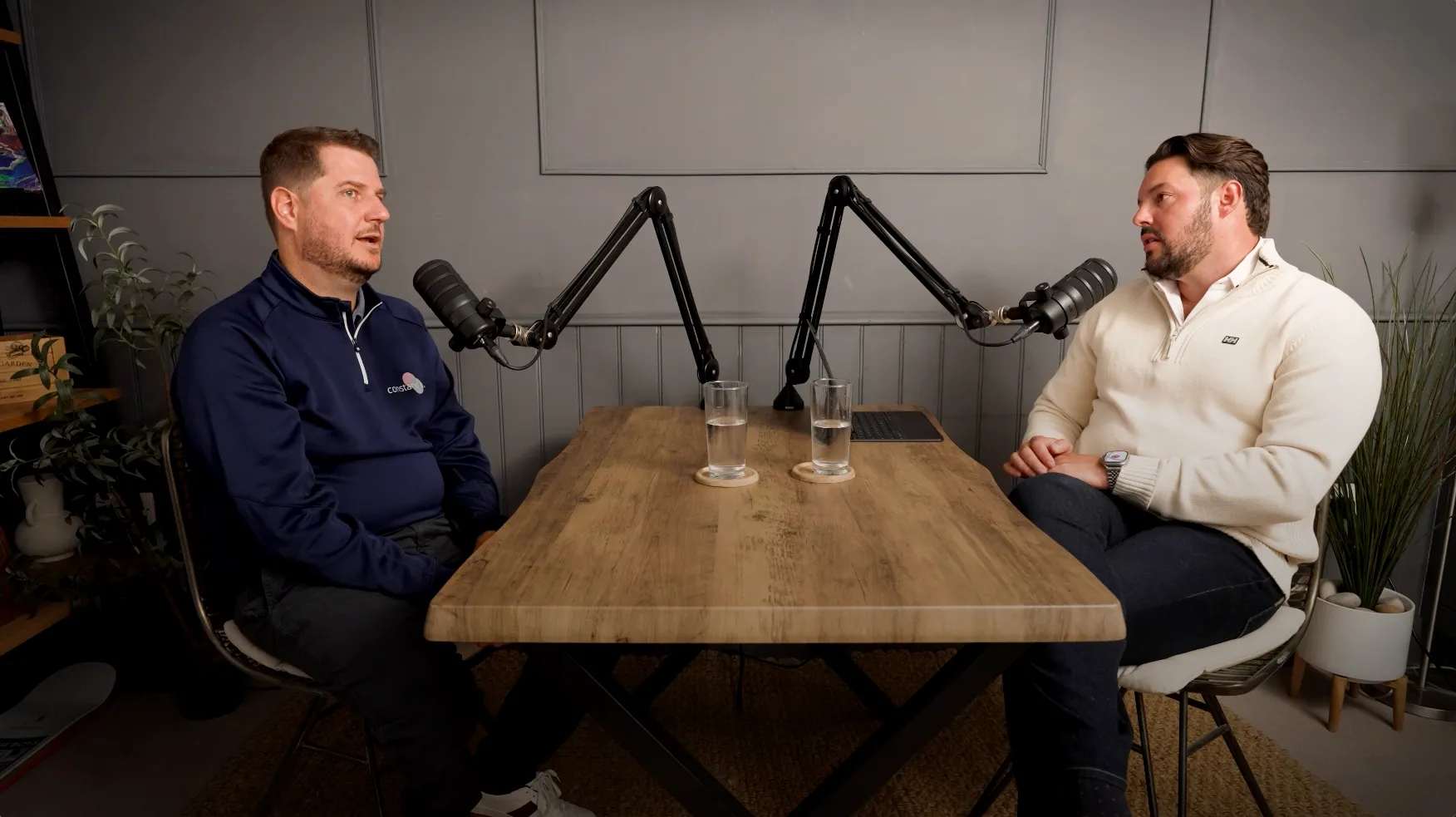
Latest episode
Brad has worked on EPM implementations for 17 years. In this 5 minute episode he names the 2 checks a finance team should run before choosing any software.
5 minute episodeAlex and Brad on what to settle before an EPM implementation
An EPM implementation moves a group's consolidation, planning or reporting onto new software, and many fail inside finance before the software is chosen. Brad, founder and COO of Constancia, an EPM consultancy, traces most failures to a finance team with no spare capacity and dirty data.
Brad sees many implementations fail because the wish list is long and nobody in finance has the hours to run it alongside the close.
Bad data loaded into the new platform comes back out as bad numbers, and the group cannot run on those.
Alex finds a long requirements list can usually be whittled down to about 15% of its items, and those items carry the value.
Moving off a tool the team has used for 20 years is a technology replacement, and the business case should call it that.
The team needs to know which processes the new platform will support before the build starts.
Alex sees the same pattern at the start of most projects, with a long list of requirements gathered from every stakeholder.
In his experience, that list can usually be whittled down to about 15% of its items, and those items carry the value for the business.
He starts by asking who needs to be involved and what each stakeholder brings to the outcome the group wants.
Then he asks the question he rates above the rest, which is what the group is actually trying to achieve with the new software.
Brad hears CFOs promise a close cut from 30 days to 10, with the new platform expected to find the 20 days.
In his experience, those days come back when the team understands the business, the process and the data behind each step of the close.
He calls the opposite belief the number 1 EPM implementation myth, and Alex adds that the technology cannot make you a coffee.
Brad sees the same rule apply to ERP and data warehouse projects, where a clear view of the process decides how much the new system can change.
Brad's rule is that the platform should automate or support about 80% of the finance function's work.
The other 20% is managed outside the platform, so the team can change it as the business changes.
Alex0:04If you're about to set off on an EPM implementation programme, here are the 3 or 4 things you should be asking yourselves internally. Brad, you've been doing this for 17 years. Give us 2.
Brad0:17Yeah, I think the first thing you need to understand is, do you have the capacity internally to run this project? I see so many EPM implementations fail because they have a big laundry list, a big wish list of things they want to do. But at the end of the day, they don't have the capacity internally to be able to do that.
Brad0:36Another thing that typically trips up EPM implementations is data quality. I think we'll touch on this a little later in this discussion. If your data is not clean, the likelihood that your implementation is going to be successful is relatively low. The reality is, if the data going in is really bad, the data coming out is really bad. And if the data coming out is bad, you're not going to be able to run your organisation efficiently, right?
Brad0:59So it's can you do it, and is your data clean? Then all the other things typically take care of themselves. Technology selection, budgets. You can normally get budget from anywhere if you can justify it. But those are the 2 fundamentals, I think, that drive a truly successful EPM implementation. What are your thoughts on that?
Alex1:19100%, I couldn't agree more. From my side of the fence, where I'm sitting, it's who needs to be involved and who doesn't. Your stakeholders. What is their value proposition to the outcome you're looking to achieve? Which leads me to the most important one. What are you actually trying to achieve?
Brad1:37Yes, true. True, yeah.
Alex1:38And what is your real scope? What are you really trying to get over the line? More often than not, you've got the big list of requirements. At the end of the day, that list of requirements can actually be whittled down to about 15%. And that's the real value driver for your organisation.
Alex1:53Let's think about it. We've been doing this for a combined 30 years of finance transformation. What's the typical thing you see? Oh, we've been on the same tool for the last 20 years, we just need to change it. That's not a transformation.
Brad2:07No.
Alex2:08That's a technology replacement initiative.
Brad2:10Correct.
Alex2:11Be very clear and concise about why you're changing the technology. That could be a financial planning and analysis tool, a consolidation tool, a management reporting tool or a statutory consolidation tool. It could be account reconciliation or going over to an AI tool.
Brad2:32True. True.
Alex2:33I'd love to hear, because you've been doing this for a long time, what is the number 1 EPM implementation myth?
Brad2:48I think you touched on it already. It's not understanding the process you're going to be enabling through these technologies. You need to really understand your process and what processes you want to wrap around these toolsets to drive that change.
Brad3:07A lot of the time I see CFOs talk about reducing their close from 30 days to 10 days, as an example. A lot of the time it's not the technology that does that. It's understanding the business, the process and the data that goes with it. That's the biggest lever of change, as opposed to the technology. So it's really understanding that.
Alex3:28Yeah, I always say the technology can't make you a coffee, right? It's not one size fits all.
Alex3:37So going back to it, say I'm about to embark on an implementation for EPM, ERP or data warehousing. Be really clear and concise on what you're trying to solve in the business before you buy the technology. That doesn't mean don't go and look at them. But make sure you're marking them on the growth they're going to enable for your business. With that in mind, Brad, what's your view?
Brad4:06It's a classic thing. It's an 80/20 split, right? You've got to automate 80%, or enable 80% of your function through technology, and 20% you can manage externally.
Alex4:18There you go.
Brad4:19And that 20% can flex. So any number of toolsets can drive the changes you're looking for. But it's really, like you said, being very concise about what you're trying to do and implementing it well, with a properly defined roadmap. At the end of the day, that will drive the change, no matter what technology you throw at it.
Brad4:38It's the best analogy I can give you. A lot of the time, people buy Ferraris and put a donkey in the engine.
Alex4:47I love that.
Brad4:48Yeah, they put a donkey in the engine and expect it to go as fast as a normal Ferrari. But maybe you can talk me through what you've experienced, and build on this analogy a little more.
Alex4:57I think it's simple, right? If you're trying to figure this out, give us a call. We can help.
We survey the data model before we quote, then implement at a fixed price.
Read the serviceA roadmap lists what must be true before each phase starts, and the dates follow from that list.
Read the articleEPM software holds the group result, and the explainer sets out what it does that an ERP cannot.
Read the explainer
Latest episode
Every Sunday, 6am
Our weekly newsletter on AI in finance.
Yours to enjoy with your Sunday morning coffee.
The people who would do the work read every message and reply inside 2 working days.
Free guide
Get our AI in finance predictions for 2027
Enter your details below and we will send a free copy to your inbox right now.
Check your inbox for your copy of the predictions.
We use cookies to improve the site and measure our adverts.Read the cookie notice
Strictly necessary
Keeps the site working and remembers these choices. Always on.
Statistics
Counts visits and the pages read, so we can improve the site. Never used for adverts.
Advertising
Lets Google and LinkedIn measure our adverts and show them to people who have visited.